|
|
|
|||||||||||
|
|||||||||||||
 |
|||||||||||||











 |
|
Ethan Nahté Ethan Nahté works for a
conservation organization and has also worked with
animals for many years. Deep in the Amazon jungle among the members of the Juma tribe, the fierce people, lurks the truth behind the legend of the Vampire bat.
“Bloodsucking Monkeys”
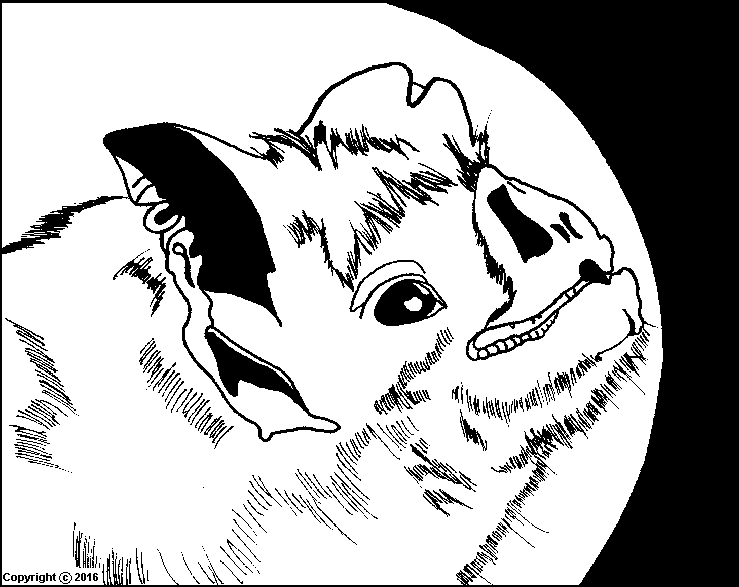
Marima and Aroka had just killed the yaguara which had been attacking their tribe along the Igarapé do Mucuim. The Mucuim River snaked its way through the heart of the Amazon Jungle, just west of the Amazon. The boys, both in their teens, were bleeding the spotted beast before tying it to a nearby piece of mahogany to transport back to their village. They were of the Juma tribe, the “fierce” people, a tribe numbering less than one hundred in the mid-twentieth century. As Aroka slit the cat’s throat, the blood spurting out across his hands, Marima asked, “Do you know the story of the bloodsucking monkeys?” Aroka looked up and shook his head. Although the old men told stories around the nightly fires, sometimes a story would be told within a hut and not to the entire tribe for many generations, risking becoming lost to time, like the Juma themselves. Aroka was the last male in his hut. His father died from disease after contact with explorers. It was the last time his tribe had seen white men before they disappeared even deeper into the forest. That was years ago when Aroka was the size of a spider monkey. His grandfather had died a couple of years later while hunting caitetu munde, the giant peccary. He killed the peccary, but not before he slipped in the mud while throwing his spear, the hog goring him before he succumbed. The meat was cooked at the funeral feast in honor of his grandfather. Marima continued as he lashed flexible vines and reeds about the mahogany, “My father tells me this story comes down to him from many grandfathers back. He says that before white explorers crossed the great water and invaded our lands, taking our gold, rubber, cashews and parrots, all the people of the Amazon feared a certain breed of monkey.” “Which monkey?” Aroka asked. “That has been forgotten, for the monkey no longer exists. It would attack people, landing upon them and biting their throat, killing the person but never eating them, only sucking their blood. Because people feared these monkeys, no one killed them for food… only for defense. “But when the Europeans arrived, wearing their metal clothing, they were safe from attack. With their sticks of thunder they killed all the bloodsucking monkeys, but not before a monkey infected another.” Aroka’s eyes widened in surprise. He asked, “Do you mean a person became so cursed?” “No, because to become one of the accursed, a victim had to drink from the monkey after the monkey drank from the victim. No person ever drank.” “Then what did?” Aroka asked, impatient to learn more. “One night while seeking a meal of insects, a bat, no larger than my thumb, stopped to rest upon a leaf high in a tree. The bat could sense something moving nearby. At the last moment the bat dropped from the leaf, just escaping the vicious strike of a young boa. He fluttered down, banging his wing against a limb and landing in a smaller tree. “The smaller tree was the resting place of bloodsucking monkeys. The stunned bat had landed on the shoulder of one such monkey, startling it awake. The monkey snatched the bat and bit into its back. The bat, in pain and scared for its life, twisted around and bit the monkey on the tongue, drawing blood and drinking it down. The monkey howled and slung the little bat into the darkness where it bounced against another large leaf and slid down deep into the Parrot's Beak flower. “The bat, weak from its injuries, lay there all night, and for two more days and a night. On the third night the bat arose, hungry. It scrambled out of the flower and sought its prey, finding a large bug. But the bat discovered it wasn't hungry for the meat, it only wanted the blood. It decided that bugs were not going to be large enough and it would take too many.” “So what did it do?” Aroka anxiously asked, enthralled by the tale of his friend. “Did the bat attack people?” “No,” Marima replied. “The bat first went after monkeys, learning to quietly sneak up on them by landing then hopping and crawling along a branch. Then they would make a small cut in an ankle or leg and lap up the blood. It didn't take much to fill him. “The problem was that bats are very sociable and live very close together in their colonies. The blood curse spread quickly, infecting the other bats in that colony and soon all of that particular bat became what is known as a vampire bat. My grandfather says that from his time around a white explorer he learned that there are only three species of vampire bats in the world, all here in South America.” “So we are in danger?” “No, Aroka. Once the white settlers brought over horses and cattle, the bats learned to feed quietly on these animals. It is rare that they bite a human. And they never take enough blood to kill. But my grandfather also said that most of the world is scared of bats, fearing that they will drink their blood or turn into a human-like creature and suck their blood. They are feared because they once protected themselves.” “That is crazy,” Aroka expressed in disbelief. “Yes, but they make stories of it to scare people. The people of the rainforest know it is a myth. As long as we don't eat or harm the bats, we won't become cursed.” “I'm just glad there are no more bloodsucking monkeys,” Aroka said. Marima laughed while they began tying the legs of the yaguara to the staff. As they lifted the body he asked, “Have I told you about the Spirit Cat that haunts this jungle?” Aroka shook his head as they moved forward, unaware of the reddish-yellow eyes watching, hidden in a tree above as the jungle floor darkened with sunset. The End |
|
[Home] [About Us] [Stories] [Story 1] [Story 2] [Story 3] [Story 4] [Story 5] [Story 6][In My Opinion] [Contact Us] |