|
|
|
|||||||||||
|
|||||||||||||
 |
|||||||||||||











 |
|
Lou Antonelli Lou Antonelli started writing fiction in middle age; his first story was published in 2003 when he was 46. He’s had 104 short stories published in the U.S., U.K., Canada, Australia, India and Portugal in venues such as Asimov's Science Fiction, Jim Baen's Universe, Tales of the Talisman, Andromeda Spaceways In-Flight Magazine, Greatest Uncommon Denominator (GUD), Daily Science Fiction, Buzzy Mag, and Omni Reboot, among many others. His collections include “Fantastic Texas” published in 2009; “Texas & Other Planets” published in 2010; and “The Clock Struck None” and “Letters from Gardner”, both published in 2014. His debut novel, the retro-futurist alternate history “Another Girl, Another Planet”, is slated for release later in 2016 by WordFire Press. His story “Great White Ship”, originally published in Daily Science Fiction, was a 2013 finalist for the Sidewise Award for alternate history. His short story “On a Spiritual Plain”, originally published in Sci Phi Journal, was a finalist for the Hugo award in 2015. “The Yellow Flag” - his 100th published short story (Sci-Phi Journal Aug. 2016) -- set the record for all-time fastest turnaround in genre fiction. It was written, submitted and accepted between 1 p.m. and 5 p.m. on May 6, 2015 Lou is a frequent contributor to 4 Star Stories, a
trend that shows no sign of abating.
A STONE’S THROW By Lou Antonelli
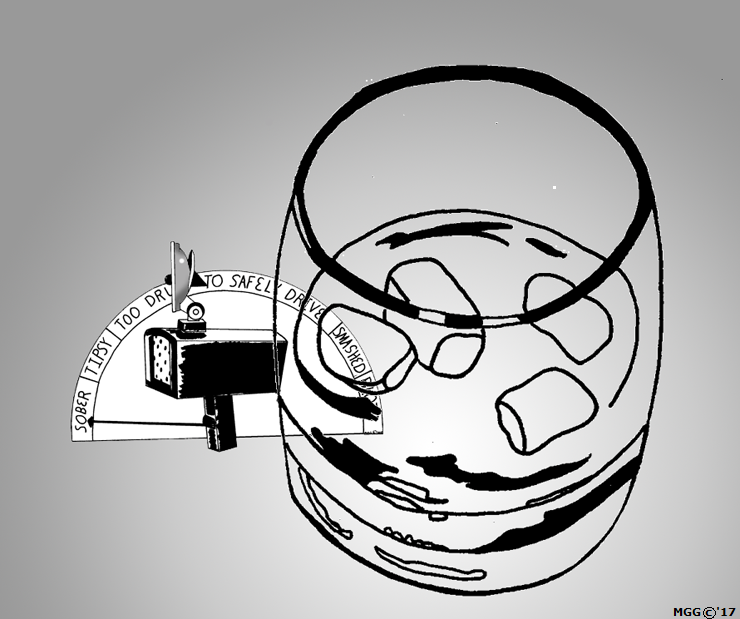
Walter stood at the open door to his neighbor’s garage. “Harry, thanks for lending me your lawn mower,” he said as he wheeled it inside. “Holy smoke!” Charlie looked up from his work bench. “Why the surprise?” “I’ve never been inside your garage,” said Walter. “It looks like an electronics lab.” “I told you I retired from high tech research and development,” said Charlie. “Yeah, but most people travel or go fishing when they retire,” said Walter. “I had no idea you were still building things.” Charlie pushed back from his seat. “This is my retirement. Dabbling with whatever I want to.” He waved a rectangular plastic case the size of a shoebox. “See this? I worked on the original prototype cell phone.” Walter looked it over. “My boss has one of these at the office. Neat idea, but the damn thing is too big.” “There’s still a lot of work to be done. I bet by 2000 they will be down to the size of a wallet.” Walter set the bulky cell phone down. “You working on something in particular?” “Yes, as a matter of fact.” Charlie reached over and grabbed a black metal case. “I have an idea for a practical electronic device that can sit on the dashboard of your car like a radar detector, but which will be much more useful.” “You figured out a way to change red lights to green?” “Very funny--that would be illegal anyway,” said Charlie. “What I’m talking about isn’t illegal though--in fact, it should save lives.” Walter sat down. “Let’s hear it.” “You ever drive down the road, and someone’s driving like an idiot?” he asked. “Sure, it happens all the time.” “Well, I got my idea from a friend who’s worked to develop diagnostic equipment that can scan parts of the body with magnetic beams to make the equivalents of x-rays,” he said. “He said it is possible to tell how well someone’s mind is functioning by reading these images. You follow me so far?” “Yes, I guess.” “Now, this is in very rough terms, since you’re a layman, but imagine if you could take a beam such as used by a police radar gun, and use it as a carrier wave for one of these brain scans, and it pings back a rough image of the inside of a person’s head--takes a rough snapshot of their brain function,” he said. “Then you compare it with images we already know indicate certain states of mind---tired, sleepy, dementia, intoxicated, and so forth.” “You mean to could sit this on the dashboard and do that to someone in the car ahead of you?” “That’s the idea. I’m sick of seeing people drive like fools, and wondering to myself, ‘What’s wrong with that person?’ Well, now we can find out. You can be just a stone’s throw away from someone and be able to tell what’s wrong with them, or whether they should be on the road at all.” “Sounds like invasion of privacy.” “Think how many drunk drivers it will get off the road.” “You’ve got a point. Does it work yet?” “Not sure, I’ve just got all the parts in place.” “Well, Mark Foster is driving down the block right now,” said Walter. “I can hear those mufflers. He always stops by The Hideaway and downs a few before coming home.” Charlie picked up the box and carried it towards the open garage door. “Watch the power cord, will you?” He held it out towards the street. “Let’s see if we get a reading.” In a moment a dinged-up blue Ford Escort with a rather glassy-eyed driver passed by. After the car passed, Charlie pushed a button. A read out appeared in red LED lights. “If this is accurate, he’s rather drunk, his brain function is quite impaired.” There was a loud metallic crash down the street. Walter walked and looked down the street. “Yeah, sounds right, he hit his own trash cans going into the driveway.” Charlie held up his black box and smiled. “Well, we might have something here.” ### Walter walked across the lawn towards Charlie. “I see the moving van, are you leaving the neighborhood?” “Sure am, old chum, I got a great deal on a retirement home in the Caribbean,” said Charlie as he sat on the patio. “In fact, I bought a small island.” “Wow, that’s fantastic. We’ll miss you! I didn’t know you had that much dough.” “I didn’t until I perfected my little black box,” said Charlie. “You know, the dashboard detector.” “Holy smoke, that must have really paid off.” “Yes, I’ve made millions off of it. Can I offer you a drink?” “Sure!” Charlie took a cut glass decanter from a tray and poured a second drink. He handed it to Walter. “We can toast my good luck and fortune. “Damn, that’s great. I’m happy for you. And I saw it when you first put it together,” said Walter. “When does it go into production?” “Never. I sold the patents to someone who will never produce it.” “What?” “It would have probably provoked a bunch of Fourth Amendment challenges, anyway, and there are certain parties who would much rather prefer it never be rolled out.” “But who would that be?” “You drink single malt whiskey?” “Sure, when I can afford it.” “You ever have any McAllen scotch?” “Heck, no, can’t afford that on a fixed income.” Charlie smiled. “I’ll send you a case.” Walter’s eyes grew large. “How much money did you get?” “Plenty,” said Charlie. “I also pretty much have an unlimited supply of spirits.” He hoisted his glass. “Here’s to tinkering in the garage!” Walter clinked his glass. “I’ll drink to that.” “You sure will,” said Charlie.
-The End-
|
|
[Home] [About Us] [Stories] [Story 1] [Story 2] [Story 3] [Story 4] [Story 5] [Story 6][In My Opinion] [Contact Us] |